Data Management at the National Science Foundation
Synectics Enterprise Data Warehousing and Business Intelligence Work
at the National Science Foundation
Researchers sponsored by The National Science Foundation (NSF) win Nobel Prizes. When it came time to for NSF to award who would manage its data warehouse and provide business intelligence tools and reports, it chose Synectics: we are authorities on data science and management.
NSF was established in 1950 and has an annual budget of about $7 billion, which it allocates to academic institutions and nonprofit organizations. It supports research and education in non-medical fields including science, engineering, mathematics, computer science, economics, and the social sciences. The Foundation uses multiple applications for its operations, including Research.gov, Grants.gov, FastLane (for proposal submissions), iTRAK (a secure login site for grantees to track applications and awards), and other internal business solutions. The NSF Data Center is a complex environment with diverse operating systems (Windows, Apple, Red Hat, Solaris, Linux/Unix, and virtual machines), and Oracle, SQL, and Sybase databases to store millions of files of data including proposals, grants, correspondence, reports, expenditures, statistics, and other information.

The EDW/BI program supports business administration, human resources, and program data. The Synectics team, which includes a subcontractor, provides onsite EDW/BI support services to the Division of Information Systems (DIS), a division within NSF’s Office of Information and Resource Management (OIRM). Several project management and development teams are supporting individual projects, including the Data Population Project (DPP), Human Resource Mart (HRM), operations and maintenance (O & M), and enterprise architecture (EA). The primary purpose of the contract is to improve NSF’s ability to analyze and report on data, which allows officials to better understand proposals, awards, projects, and funding.
Synectics uses two BI tools at NSF: Tableau 10, and Oracle Business Intelligence Enterprise Edition (OBIEE). Tableau 10 provides NSF users the ability to quickly create visualizations to gain better insights into their grants data. When Tableau 10 is integrated with OBIEE (using BI Connector), it provides users the capability of performing ad hoc analyses and visualizations of existing OBIEE reports. Business intelligence at NSF is a distributed, multi-tier system. Several Oracle databases are hosted in a multi-server Solaris Sun SPARC containers or Solaris Zones. Structured data is inserted into the Oracle database via SAS Data Integration and Oracle PL/SQL procedures. NSF had developed a data warehouse based mainly on Sybase databases residing on Sun Microsystems equipment running Solaris Operating System. Microsoft SQL Server support commercial off-the-shelf (COTS) products (Siebel, Radia, Hercules, etc.) and is based primarily on servers running Microsoft Windows Operating System.
For this project, Synectics provides IT support and training in the following service areas:
Reporting: A wide array of reporting transpires, including financial, operational, and performance reports. Synectics provides NSF the ability to create formatted and interactive reports, with or without parameters, with highly scalable distribution and scheduling capabilities.
Dashboards: We create intuitive interactive displays of information, including dials, gauges, sliders, check boxes, and traffic lights. These displays indicate the state of the performance metric compared with a goal or target value.
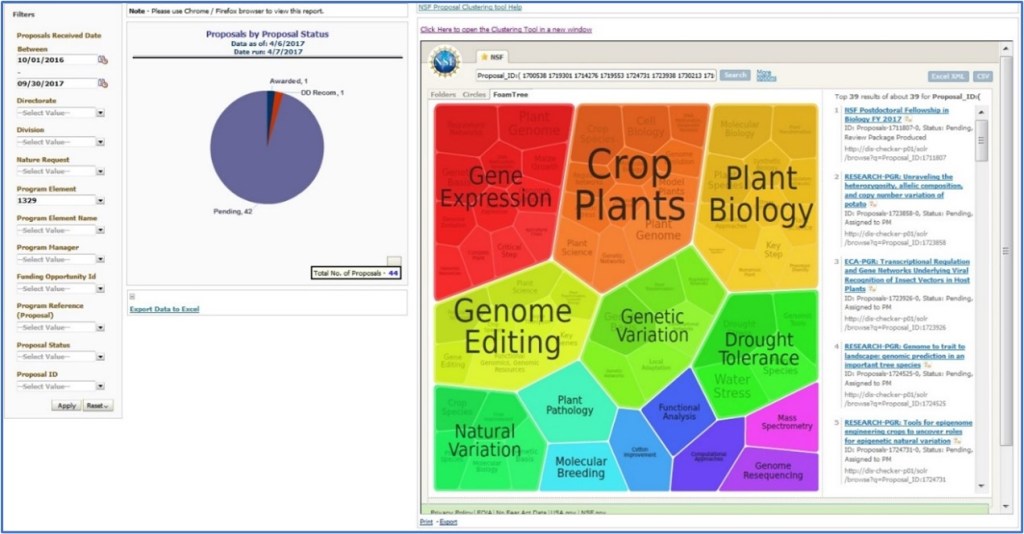
Above: A Synectics colorful NSF dashboard displaying scientific areas of awards
Ad Hoc Queries: We want NSF end-users to have the capability to ask their own questions of the data without relying on IT to create a report. To do so, we create a robust semantic layer to allow users to navigate the available data sources either onsite or remotely.
Search-based BI: We provide a search index to both structured and unstructured data sources and map them into a classification structure of dimensions and measures that end-users can easily navigate and explore using a search interface.
Mobile BI: Synectics provides NSF end-users the ability to access reports and BI tools on mobile devices, allowing users to take advantage of common interactions (tapping, swiping), and use location awareness.
Improvements in reports and analytics allows NSF stakeholders to better analyze its investments in research projects, and in its own internal operations. NSF-funded researchers have won over 175 Nobel Prizes, and Synectics is proud to do its part to pave the way for future prizes.
 Richard Ries Portfolio
Leave a comment