Clearing the Air _ _____
Richard A. Ries
How CGH Contributes to Air Safety during Rocket Launches and Reentries
The musical group Blood, Sweat, and Tears once famously sang that “what goes up, must come down.” For commercial space flights, this simple adage of gravity has potentially grave consequences for anyone flying. Ever since the tragic 2003 explosion of the Space Shuttle Columbia, the Federal Aviation Administration (FAA) has been monitoring the launch and reentry of vehicles to protect the public and property from damage from off-nominal events such as an explosion or unplanned structural failure. As Virgin Galactic, Blue Orbit, SpaceX and other companies continue to develop launch and reentry vehicles working toward “space tourism” providing stellar views of the Earth or overnight stays in zero gravity, the FAA Office of Commercial Space Transportation (AST) is required to track and monitor each of their missions. The Joint Space Operations Group (JSpOG), comprised of representatives from Air Traffic Organization (ATO) System Operations and AST monitors each mission at the FAA Air Traffic Control System Command Center (ATCSCC).
CGH Technologies, Inc. is providing technical expertise and project management to the FAA in the design, development, and acquisition of the Space Data Integrator (SDI) system to automate the monitoring of commercial launch and reentry vehicles. This system receives telemetry data directly from the vehicle operator and displays vital information on the Enhanced Space Data Display such as times of important milestones in the mission and compliance to the planned flight path. The SDI system’s goals are: (1) to reduce the size of restricted airspace needed by a launch or reentry operation, (2) to rapidly respond to an off-nominal event, and (3) to release the airspace as quickly as possible so that commercial aircraft can resume their normal flight paths. If there is an off-nominal event, the SDI system quickly calculates an Aircraft Hazard Area (AHA) to identify the area of airspace that encompasses the debris generated by the breakup of the vehicle. In addition, the SDI calculates when the airspace will be clear of debris. Currently, the calculation of AHAs is labor intensive and very cumbersome. The process requires three JSpOG personnel to manually collect and enter data on separate laptops. The calculation of the AHA could take up to 8 minutes, depending on the altitude of the vehicle.
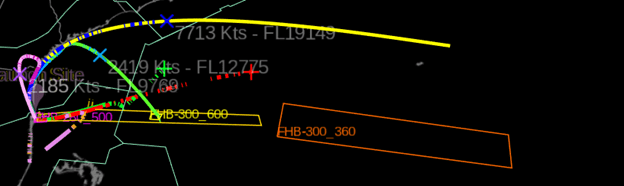
Above: Aircraft Hazard Areas being generated for liftoffs over the Atlantic
In parallel, CGH is working with AST to design, develop, and acquire a system to automatically calculate an AHA in less than 15 seconds. The Enhanced AHA Generator softwarewill use the last state vector from the vehicle (i.e., the position and velocity) and either actual weather data or a statistical representation, along with other data provided by the vehicle operator prior to the operation, to calculate an AHA coordinates. The data provided by the vehicle operator prior to the operation includes how the vehicle will breakup, the makeup of the debris, the likely size of the pieces, and the like. The Enhanced AHA Generator system must be able to model the trajectory of the debris, develop histograms of impact probability densities, and determine the boundary coordinates of the AHA within this 15-second time limit. Once the AHA is calculated, the SDI displays it in either a two-dimensional (2D) or three-dimensional (3D) representation to the JSpOG operator. If approved by JSpOG, the SDI sends a message to the Traffic Flow Management System (TFMS) providing situational awareness to air traffic managers of this potentially hazardous airspace. CGH’s technical support also involved with the design of the messages and writing Java Messaging System Description Documents (JMSDD) to provide launch and reentry vehicle position reports, mission flight plans, and AHA coordinates to the FAA’s System Wide Information Management (SWIM) program for further distribution to international customers.
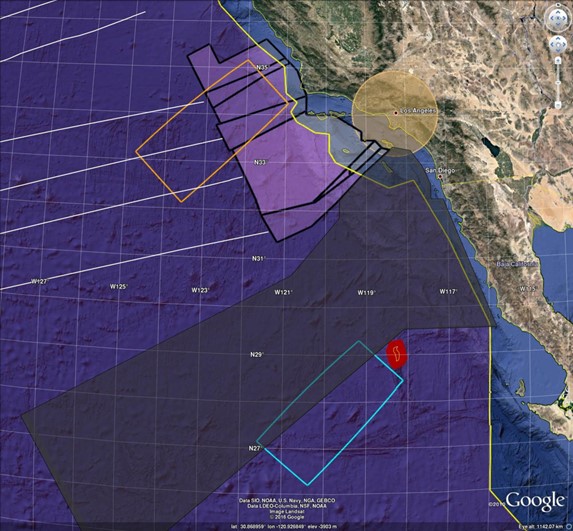
Above: Aircraft Hazard Areas for rocket reentries in the Pacific Ocean off the coast of California
The two-phased project requires extensive research, planning, quality control, and training. CGH has submitted a long list of deliverables and acquisition documents to the FAA that include a Shortfall Analysis Document and an overall Concept of Operations (ConOps). For each of the SDI and Enhanced AHA Generator efforts, CGH has developed a preliminary and initial Program Requirements Document (pPRD and iPRD), a Functional Analysis Document, a Verification Requirements Test Matrix (VRTM), a Range of Alternatives document, Enterprise Architecture artifacts, an Integrated Logistics Support Plan (ILSP), and an Information System Security Assessment (ISSA). Full implementation of the new SDI and the Enhanced AHA Generator systems – including the development, testing, and acceptance, followed by training of air traffic controllers – will take several years.
 Richard Ries Portfolio
Leave a comment